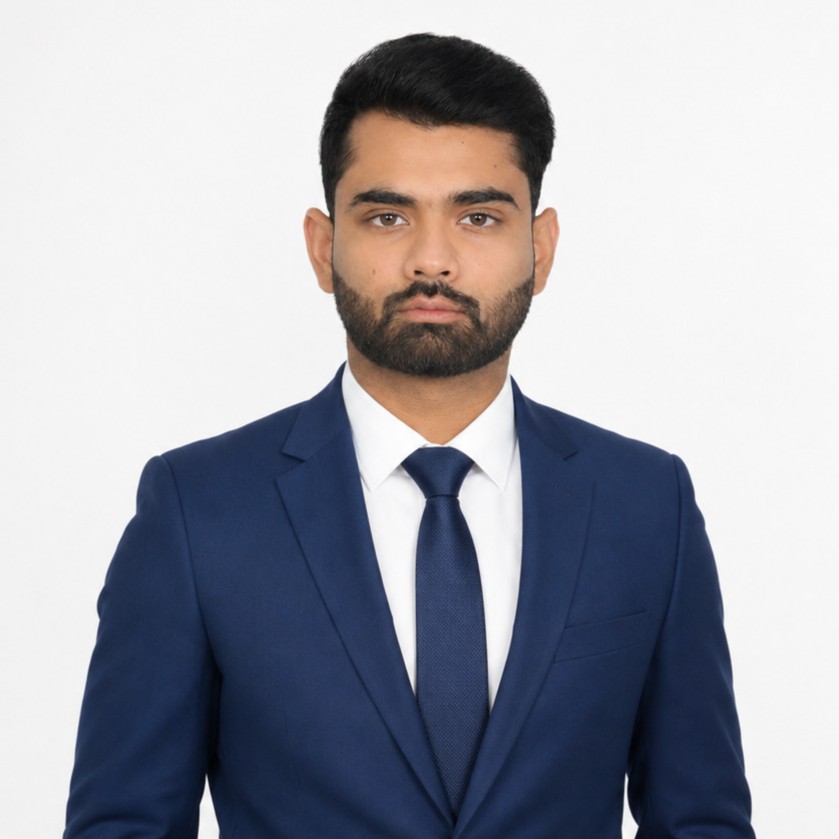
Deep Narayan Sarkar
Deep Narayan Sarkar
Advocate
Deep Narayan Sarkar is a dynamic litigation and dispute resolution lawyer with a proven track record before the Supreme Court of India, Delhi High Court, National Green Tribunal, and various tribunals across the country. Having worked alongside some of India’s most distinguished legal minds namely Mr. Siddharth Luthra, Senior Advocate, Mr. Pramod Kumar Dubey, Senior Advocate and Ms. Ruchira Gupta, Standing counsel for the State of Goa and Jharkhand, he brings a rare combination of courtroom advocacy, strategic thinking, and meticulous drafting to every matter.
His practice spans criminal law, white-collar crime, constitutional litigation, arbitration, commercial disputes, infrastructure matters, land disputes, and public law. He has been involved in several high-profile and reported matters, including appearances in landmark cases before the Supreme Court and High Courts.
An alumnus of O.P. Jindal Global University, Deep has been recognized for exceptional leadership and institution-building, receiving multiple Dean’s and University awards. Beyond litigation, he is an accomplished legal researcher with published works in leading law journals and has advised government bodies, public institutions, corporations, and private clients on complex legal challenges.
Known for his client-centric approach, strategic advocacy, and commitment to excellence, Deep Narayan Sarkar is dedicated to delivering practical, effective, and result-oriented legal solutions in matters of the highest complexity and significance.
Representative Experience
2022 SCC Online SC 539
Vicarious Liability of partners in a partnership firm
2024 (1) SCC 632
The Hon’ble Supreme Court quashed the termination of a university lecturer accused of sexual harassment because the Internal Committee conducted its inquiry in “undue haste,” violating the principles of natural justice by failing to afford him a reasonable opportunity to be heard.
WP(C) No. 531 of 2025 [Supreme Court of India]
Ayesha Jain, a student at Amity University, Noida, petitioned the Supreme Court of India after university officials allegedly harassed and barred her from classes for changing her name. The case prompted the Supreme Court to launch a sweeping nationwide audit into the establishment and governance of all private universities in India.
Criminal Misc. Case No.5536 of 2014 [Delhi High Court]
In B.K. Parchure v. State & Anr. (2022), the Delhi High Court held that a public servant (Tehsildar) accused of fabricating an incorrect land map during a court-ordered re-demarcation drive was protected from criminal prosecution under Section 197 of the CrPC, as his actions had a reasonable nexus with the performance of his official duties and therefore required prior government sanction.
Tampering case in the Upahaar Tragedy case
The Supreme Court ruled that an insurance company must reimburse medical negligence compensation up to the policy limit if the insured doctor or hospital is found liable.
Law on Look-out Circular [LoC]
The case involves a constitutional challenge to the validity of several sections of the Waqf (Amendment) Act, 2025, where the Supreme Court of India evaluates and partially stays specific provisions at the interim stage while refusing to stay the entire statute.
Publications
- Sharma, Shilpi, Sahni, Sanjeev P. and Sarkar, Deep Narayan (2023) Non-pecuniary motivations for self-employment: Data from a MOOC on social entrepreneurship. Psychological Studies, 68 (3). pp. 291-309. ISSN 0974-9861
- Deep Narayan Sarkar, The Economic Impact of Covid-19 in the World, 10 PEN Acclaims (May 2020)
- Deep Narayan Sarkar, ‘The Nuremberg Trial and Its Impact in Developing the International Criminal Court and Law’ (2020) 2(4) FastForward Justice’s Law Journal (ISSN 2581-6713).
- Deep Narayan Sarkar, ‘Case Commentary—Y Narsimha Rao and Ors v Y Venkata Lakshmi and Anr’ (2020) 1(IV) LexForti Legal Journal (ISSN 2582-2942)
- Deep Narayan Sarkar and Ratnadipa Sarkar, ‘The Human Rights Regime and Right to Equality Do Not Sufficiently Account for Intersectionality of Discrimination’ (2020) 17 Supremo Amicus.